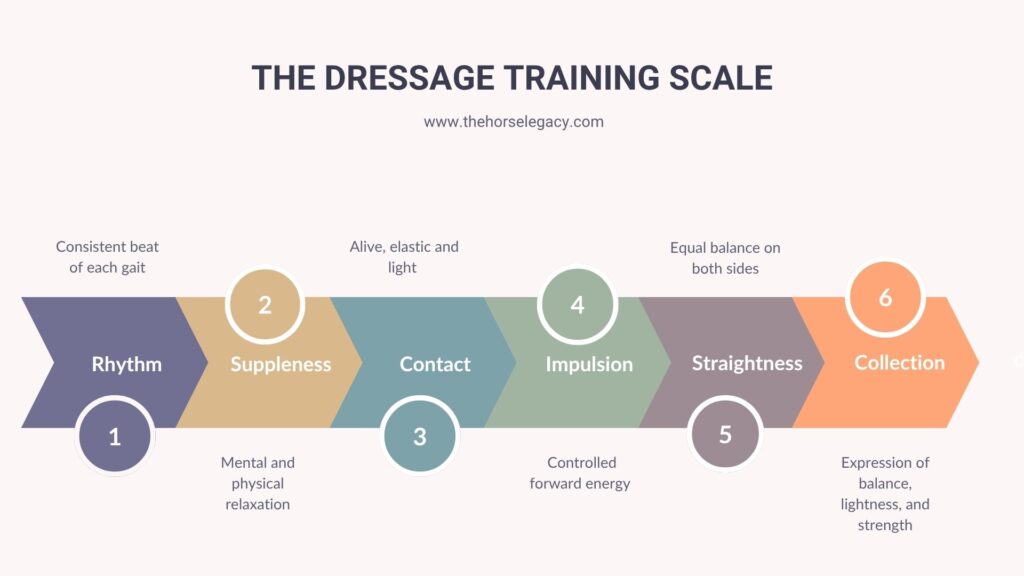
When I started dressage riding, I often wondered what made advanced riders look so effortless. The answer lies in the dressage training scale. It gives me a clear path to building a harmonious connection with my horse. Step by step, it helps me understand rhythm, balance, energy, and lightness. This scale is not just a list of skills — it is a journey toward a true partnership.
1. Rhythm: The Foundation of Every Movement
Rhythm is the starting point for everything. It is the regular, even beat of every gait. Each step should be of equal length and duration. In walk, trot, and canter, I check that the rhythm remains consistent. Even during transitions, turns, and curves, the rhythm must stay clear. When the rhythm is lost, the horse often shows tension or imbalance. That’s why I observe closely how my horse moves in each basic gait. Only when the sequence of steps flows evenly can I say the rhythm is right. A clear rhythm gives my horse confidence and relaxation.
- Rhythm is fundamental: It’s the consistent, regular beat of each pace (walk, trot, canter).
- Consistency is key: Every step should have the same length and timing.
- Check at all times: Maintain rhythm during transitions, turns, and curves.
- Signs of lost rhythm: Tension or imbalance in the horse.
- Monitor movement: Pay close attention to how the horse moves in each basic gait.
2. Suppleness: The Key to Softness and Trust
Suppleness comes right after rhythm, so I build it on a steady tempo first. Then I ask my horse to soften through the whole body, not just the neck. I look for elastic muscles and even joint motion on both sides, because symmetry supports efficient movement and reduces overload. I create suppleness by riding for both physical and mental relaxation. I encourage a calm nervous system with clear, consistent aids and timely releases, because the release teaches my horse where comfort lives.
When I soften or briefly give the reins, I want my horse to reach forward and down while keeping the rhythm and balance. That stretch tells me my horse trusts the contact and can lengthen the topline without falling onto the forehand. However, I stay honest: chewing the bit alone does not prove relaxation, because some mouth behaviors can also relate to discomfort or conflict. So I look for a whole-horse picture—steady rhythm, soft back, quiet eye, and elastic responses.
3. Contact: The Language Between Horse and Rider
Once I lock in rhythm and relaxation, I build contact. I do not create contact by pulling. Instead, I let my horse step forward from my leg and seek a soft, steady connection. I follow that reach with a quiet hand. Contact feels alive, yet it stays soft. So, I ride the energy from the hindquarters over a swinging back into my hand. I keep the reins elastic by releasing on time. I never pull; instead, I drive the energy from the hindquarters forward over a swinging back.
Finally, I watch the details. The reins feel light and springy, not empty and not heavy. The poll remains the highest point, and the line of the nose stays slightly in front of the vertical. The mouth stays quiet and relaxed, chewing gently. This harmony allows balance and rhythm to flow through the body. Contact, therefore, connects the aids of rider and horse into one fluent dialogue.
4. Impulsion: Energy and Power from Behind
Next, I focus on impulsion. It is not speed. It is the controlled, forward energy that comes from the hindquarters. Impulsion adds life to the movement. When impulsion develops correctly, my horse’s steps become expressive and elastic.The energy must stay controlled and rhythmic, not rushed. The moment of suspension becomes visible, especially in trot and canter.
The energy flows from behind, through a supple back, to the bit. That power creates lightness in the forehand and a feeling of uphill movement. To build impulsion, I ride transitions, lengthenings, and gymnastic exercises. Step by step, my horse learns to carry more weight behind and move with athletic power.
5. Straightness: Balancing Both Sides of the Horse
Straightness helps me guide my horse evenly on both reins. Horses are naturally crooked, so I work to align shoulders and hindquarters.Therefore, straightness means that the hind feet follow the line of the forefeet. My horse is straight when it bends equally to both sides and keeps its body aligned on curves and straight lines.
A straight horse can use its hind legs evenly. It learns to push equally from both hind legs, directly toward the center of gravity, not sideways. Straightness prevents uneven wear and strengthens both sides equally — everything becomes smoother and more harmonious. Only a straight horse can be truly supple, balanced, and ready for collection.
6. Collection: The Expression of Balance, Lightness, and Strength
Collection is the final step of the scale of dressage training. It develops naturally from the previous levels. In collection, my horse shifts more weight to the hindquarters, lifts the forehand, and shortens the frame slightly without losing energy. It’s not about shorter strides, but about carrying power in balance. Collection feels like dancing — soft, proud, and connected. It is the result of trust, patience, and years of building from the basics.
Through half-halts and lateral work, I teach my horse to carry more weight behind. The joints bend, the back becomes round, and the movement feels elevated. A collected horse moves with ease and self-carriage. I feel light in the saddle, and my aids become subtle.
However, collection must develop gradually. If I demand too much, the base of support becomes too short, and balance is lost. True collection always combines engagement, elasticity, and calm energy.
Conclusion
The dressage training scale is not a checklist. It is a living system that guides me daily. At the same time, it teaches me that progress comes through patience and understanding. Each step builds upon the next. Rhythm creates relaxation, relaxation enables contact, contact channels impulsion, impulsion promotes straightness, and straightness leads to collection.
When all six elements work together harmoniously, my horse becomes balanced, powerful, and self-assured. The result is a partnership based on trust, clarity, and joy in movement. That, for me, is the true art of dressage.