When I first learned the structure of a dressage test for beginners, I realized how much structure and rhythm it teaches. Every movement has a purpose. Each transition helps me connect better with my horse. The test is designed to measure how well I can guide my horse through a series of patterns, turns, and gaits in harmony. Although the test looks simple on paper, it requires focus, rhythm, and coordination.
How I Prepared My Horse for the Test
Preparation is everything. Before riding the full test, I practice each exercise separately. I work on circles, half halts, and balanced transitions. Moreover, I make sure my horse is supple and relaxed. Repetition builts trust. Consistency creates rhythm. Gradually, we can ride the entire sequence smoothly, without tension or confusion. Through half halts, I help my horse rebalance between movements. That improves contact, self-carriage, and communication.
Starting the Test with Confidence
I begin by riding into the arena at A in working trot. I ride straight toward X, halt in the center, and salute. Then I trot on with calm determination. From that first moment, I know that these seconds set the tone for the entire performance that follows. Even a simple greeting shows how well I connect with my horse. After greeting, I move on in working trot, keeping my position relaxed but balanced. My horse stays attentive, and I focus on rhythm and even contact. Every horse has its own natural tempo. My task is to feel it. Once I find that balance, the rest becomes easier.
Smooth Turns and Serpentine Lines
I continue to ride on the left rein, keeping a steady rhythm. Along the second long side, I ride a simple serpentine line from F to M. This exercise helps me loosen my horse and prepare for transitions, therefore it demands control and softness. The line must flow naturally, not only for my horse but also for me. Then I change rein across the diagonal, from C to A, crossing X. This change improves suppleness and shows how smoothly I can shift my horse’s balance from one side to the other. Moreover, it reminds me to ride both hands equally, maintaining balance and lightness on each side.
Balance And Circles in Motion
At E, I transition to medium walk. My horse stretches slightly forward and downward. Soon after, I return to trot and ride a three-loop serpentine starting at C. Each loop helps me improve balance and coordination. I finish shortly before A, preparing for canter. When reaching A, I ask for right-lead canter. I keep my inside leg guiding the bend while maintaining a soft outside rein. I ride a 20-meter circle by crossing X. Circles and serpentines are the core of every dressage test for beginners. They teach me that precision is not about speed but about harmony and control.
Transitions Between Trot and Canter
At A, I transition back to working trot, showing control and relaxation. Transitions truly make or break a dressage test for beginners. They reveal balance and understanding and I make sure to prepare early. Exactly at X, I change direction to the left rein, keeping my horse straight and attentive. At C, I strike off into canter at working speed, riding one round on the circle. Back at C I continue with riding the whole arena. When I reach H, I pick up at medium canter to show activity and impulsion. Then at K, I change into working canter, while already preparing to slow down into a working trot at A. The better my timing, the calmer my horse remains.
Practicing the Turn on the Forehand
I halt on the long side at B and practice a turn on the forehand. A turn on the forehand is one of the most valuable exercises for beginners in dressage. Although not part of the official test, this exercise is one of the best ways to improve communication. My horse learns to yield to my inside leg and step sideways with crossing hind legs. For me, it develops better feel, clearer aids, and an improved sense of rhythm. Afterward, I walk forward in relaxation and prepare for the final salute.
For more information on how to ride the turn on the forehand - check this out:
Mastering the Turn on the Forehand for Beginners — Step by Step
The Final Halt and Stretch
To finish, I move off in medium walk. I walk down the centerline from A to X, halt, salute — and smile. I turn in medium walk and let the reins slip and allow my horse to stretch in free walk on a long rein. This moment of relaxation is essential. It shows trust, respect, and balance between horse and rider. Each test, no matter how simple, helps me grow. With every new attempt, I gain confidence and harmony.
Why Every Beginner Should Try It
A dressage test for beginners is like a roadmap for learning. It teaches focus, control, and awareness. Because the sequence combines all basic gaits and figures, I grow as a rider with every repetition. In addition, my horse learns to move in in rhythm and confidence. Each part improves my coordination, balance, and sense of timing.. Once I mastered this dressage test for beginners, I felt ready for more — ready to ride with purpose, balance, and pride.
Go for it!
Dressage Test
dressage Arena: 20 x 40 meter, Duration approx. 4 minutes
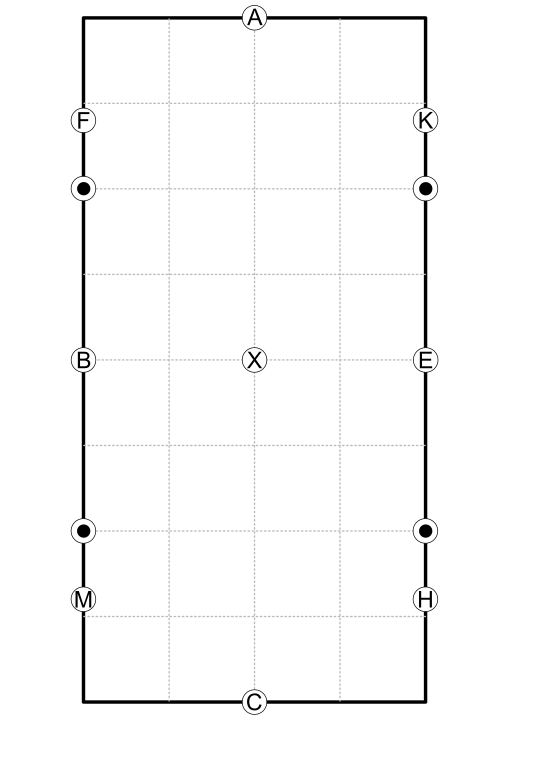
(A–X) Enter at working trot. Keep center. Salute.
(X) Transition to working trot.
(C) Left rein
(F–M) Simple serpentine (left hand) on the second long side.
(C–X–A) Change through the length of the arena.
(E) Center of the next long side, center step (right hand).
(C) Center of the short side, trot at working pace (right hand)
(C–A) Serpentine through the arena, 3 bends, finish on the right. (A–X–A) Canter at working pace from the middle of the short side, riding on the circle (one round – right hand).
(A) Working trot from the middle of the short side (right hand).
(A–X–C)Change to the other reign.
(C–X–C) Canter in at the middle of the short side at working speed, riding on the circle (one round – left hand).
(C) Middle of the short side, whole arena (left hand).
(H–K) Next long side, medium canter (left hand).
(K) Before the short side, working canter (left hand).
(A) Middle of the short side, working trot (left hand).
(B) (Ridden on the second track in the indoor arena.)
Halt at the middle of the long side (left hand).
Turn On the forehand. Ride in at a medium walk.
(A) Turn onto the center line (left hand).
(X) Halt at the center. Salute. Ride in at a medium walk.
Let the reins hang loosely from your hands. Leave the arena on a long rein.
This beginner dressage test does not represent an official pattern from any national federation. It is designed as an equivalent training exercise to reflect the structure and difficulty of entry-level dressage tests: 🇩🇪Germany: E/A Level, 🇬🇧United Kingdom (British Dressage): Preliminary, 🇺🇸 United States (USDF/USEF system). Its purpose is to help riders and horses practice rhythm, balance, and harmony in a simplified format.