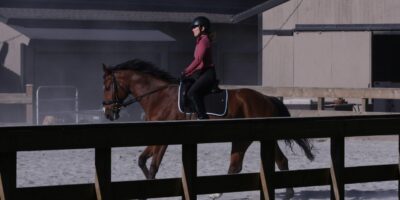
When I speak of the circle of aids, I refer to the living, dynamic system of communication between my body and my horse. When I ride well, I do not use my aids individually. I rather connect them. My leg releases the energy, my seat shapes it, my hand receives it and gives it back. This way, the horse receives a clear message, not three separate signals. This circle creates the feeling that riders are looking for. The back swings. The contact remains flexible. The horse carries itself. In other words, the circle of aids becomes natural system, not just a nice idea.
So, if you want to fix a broken connection, do not start with stronger hands, but with a better circle.
What the circle of aids really does in the horse’s body
Energy has direction. It comes from the hind legs. It travels over the topline. Then it reaches the poll and mouth. Finally, it flows through the reins into my elbows, shoulders, and back. However, the loop only works when I send energy forward and receive it without blocking. Therefore, “connection” does not mean holding the head. It means guiding a moving body. You can often see it immediately:
- When the circle works, the stride stays rhythmic and the neck feels alive.
- When it breaks, the back drops, the steps shorten, and the contact turns heavy or empty.
So I ride with one question in mind: Does my horse keep the flow from its hind legs to my hands and back again?
The leg: impulsion starts with timing, not pressure
Every correct movement starts with a small but purposeful driving aid – a clear “go”. Yet “go” does not mean hurry. My calves encourage the hind legs to step deeper under the body. In addition my leg must stay close yet relaxed at my horse’s body. If it grips, I lose feel. Meanwhile, a swinging leg arrives too late. A calm, steady leg feels the horse’s breathing and rhythm. Here is my simple rule:
- Ask.
- Stay close.
- Reward.
If hind legs trail behind, my horse’s back drops. Consequently, my seat loses influence. My hand starts to compensate. This is exactly how riders accidentally break the circle.
A useful feel-check: when my leg works, the horse’s ribcage feels fuller under my inside calf. My horse’s back meets my seat instead of escaping from it. Hence, my horse learns to trust my leg and respond with elasticity.
The seat: the “switchboard” that channels energy
Once the hind legs step under, the movement reaches my seat. Now I either allow it, shape it, or block it. I aim for a seat that follows first. I do not push. Instead, through my seat, I influence tempo, rhythm, and direction. That means I keeping my core stable and my hips elastic at the same time.
If I lose my balance, the horse loses its back. In addition, the horse often protects itself by tensing its neck or leaning on the contact. That is why I consider my seat as the heart of the system.
These cues help me stay authentic:
- My pelvis moves with the gait, not against it.
- My breathing stays clam, especially before transitions.
- My shoulders stay over my hips, and my hips over my heels.
As a result, the horse finds a position to lift and swings its back. The more harmonious my seat, the better the horse understands the aids. This harmony allows the horse to move freely.
The hand: the lightest link, yet never an afterthought
My hands do not create collection. They only shape what my legs and seat send forward. Therefore, I keep them quiet, elastic, and connected to my seat through my elbows. When my elbows stay close to my body, my hands become an extension of my seat.
I think of my hand as a receiver. It “listens” first. Then it responds. For example, if I want more balance, I do not pull the reins. I briefly close my fingers, support with my core, and soften again. Immediately afterward, I “refresh” the hind leg so the horse regains its freedom of movement. A light hand completes the circle by guiding energy back toward the hind legs.
This detail changes everything:
- A rein that only takes creates resistance.
- A rein that receives and gives back builds trust.
If you want to fix the broken connection between your aids and the reins, your hand must feel like an extension of your seat, not a separate tool. A practical tipp: in a good contact, I can feel the stride in the reins without feeling weight.
The interplay: leg to seat to hand, and then back to leg
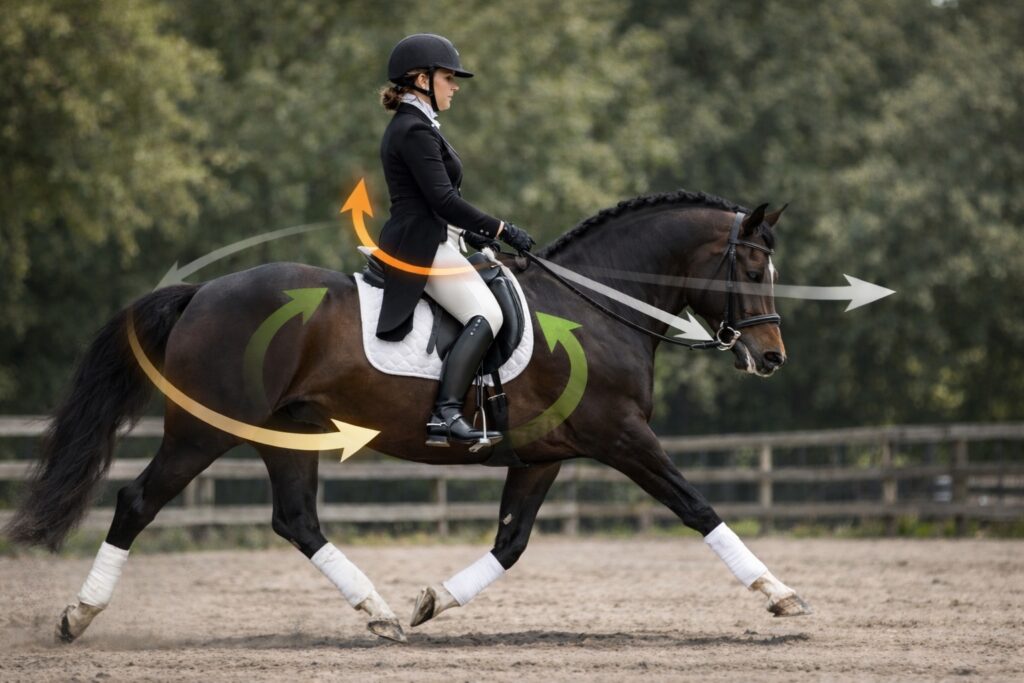
The circle of aids becomes unbalanced if the sequence is not correct. The horse then disconnects and either rushes, leans, or shuts down. To fix a broken connection I strictly adhere to the sequence:
- Leg generates energy.
- Seat channels and balances it.
- Hand refines it and returns it.
Then I repeat. Every stride. That is why the circle of aids feels like a dialogue. I give an aid. The horse responds. Then I adjust. When I maintain this connection, my horse becomes light, responsive, and self-carrying. In contrast, when I ride “aid by aid,” I start arguing with the horse’s body.
A short classical reminder: I want an elastic horse, a light hand, and a seat that rides in the horse’s balance, not on top of it.
Quick diagnostics: how I know the connection just broke
I do not wait for a full-blown problem. I look for subtle warning signs. Then I correct them within one or two strides.
Signs the connection broke
- The contact turns heavy, or it disappears completely.
- The pace changes involuntarily.
- The neck shortens and the strides become flatter.
- The inside bend disappears, or the shoulder drops out.
- The horse stops chewing and its jaw feels locked.
My “one-stride repair”
- First, I refresh one hind leg with a light, quick calf.
- Then I steady my seat and exhale to slow the body, not the hand.
- Finally, I soften the rein a fraction as soon as the back lifts.
In other words, I create energy, I balance it, and I reward it. That cycle rebuilds the loop fast.
Training ideas for an invisible connection
I prefer exercises that promote clarity without applying pressure. Therefore, I choose movement patterns that improve timing and balance.
1) Transitions within the gait
For example: from a working trot to a more collected trot and back again. I keep it subtle. Moreover, I insist on the order: leg, seat, hand, release.
2) The “three good strides” rule
I ask for three strides with improved contact. Then I give in. This strengthens the horse’s confidence and keeps me precise.
3) Circles with a purpose
On a 20-meter circle, I ride a clear inside leg to outside rein connection. Then I change the bend for a few strides. After that, I return to the circle. TThis allows me to check if the horse maintains the contact and if my aids are consistent.
4) Simple lateral work as a test
A few steps of leg-yield can reveal everything. If the shoulder escapes or the neck twists, the circle is already weak. Therefore, I slow down, reestablish the rhythm, and rebuild the loop. Over time, the aids become quieter. The horse carries itself more. The rider does less. That is the goal.
Conclusion: the circle of aids is your system for self-carriage
The circle of aids turns riding from mechanics into communication. It also protects the horse’s body, because it encourages a lifting back and stepping hind legs. Therefore it represents the foundation of all refined riding.
If I remain true to the order – from leg to seat to hand, and back again – I ride with less visible effort and more real influence. This is how I fix a broken connection in daily training. The moment this happens, my horse becomes light, responsive, and truly with me – the essence of classical riding.