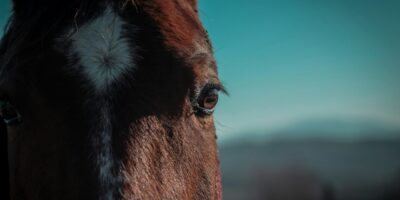
Riding starts in my head. However, my head follows my eyes. So, when I want to stop staring while riding, I first change the way I look. I use a softer, wider gaze. Then my body follows. Consequently, my seat steadies, and my horse often moves more freely. The idea comes from a simple contrast: starring, fixed eyes versus a wide, open eyes.
Starring narrows my world and tenses my body
When I fixate on a single point, I narrow my field of vision. I focus my attention on details. For example, I might fixate on the horse’s ears, a letter on the wall, or the next pole. At first, this feels “concentrated.” But this concentration comes at a price. My neck stiffens. My jaw clenches. My shoulders hunch. At the same time, my breathing often becomes shallower without me even realizing it. As a result, my pelvis loses its momentum. Then the rhythm changes. Consequently, the horse may take shorter strides, appear hurried, or seem less fluid.
open Eyes widen my attention and calm my nervous system
Having a wider field of vision does not mean that I am unfocused. Rather, it means I keep my eye on the main subject while simultaneously taking in the entire scene. In addition, I also pay attention to movements at the edges. This matters because the brain uses a broad visual spectrum for balance and orientation. With a wider field of vision, I feel more present. Moreover, I become aware of my body earlier. This early signal helps me adjust before tension builds up. As a result, I ride with less “micro-bracing,” and my horse often stays more forward and relaxed.
A quick test that shows the difference in seconds
I use a simple method. First, I focus on an object in front of me. Then I stare at it for a few breaths. After that, I broaden my gaze. I keep the object centered, but expand my awareness to the left, right, above, and below. The difference is clearly noticeable. With a fixed gaze, I perceive less. With an open gaze, I notice more without effort. This allows me to keep an eye on the arena, the letters, and the other riders while maintaining my line.
What changes in my seat and in my horse
A wide, open gaze changes the rider as it influences posture through attention. Then the horse changes, too. So I watch for three practical effects:
- A quieter upper body. The shoulders drop, and the hands become steadier.
- More “whole-body” riding. I feel the horse’s back and my pelvis earlier.
- Less unnecessary tension. The ride feels lighter. Therefore, forward movement often becomes easier.
I do not force any of this. Instead, I let the gaze shift lead the body shift. That makes the change repeatable.
My on-horse reset that works even on a bad day
When the ride gets messy, I reset in a clear order. First, I lift my gaze to a neutral horizon. Next, I soften my focus as if I look “through” the space, not “at” a single point. Then I check my peripheral awareness. For example, I notice the arena fence and the corners without turning my head. After that, I ride one simple figure. A 20-meter circle works well. Meanwhile, I keep the gaze wide and calm. If tension returns, I repeat the reset. Consequently, I regain rhythm faster than with seat corrections alone.
Mistakes I avoid so the method stays effective
A few traps appear often. So I name them clearly.
- A wide gaze does not mean “sleepy” eyes. I stay alert. I just stop hunting details.
- I do not freeze my head. A quiet head helps, yet natural movement remains fine.
- I do not “try harder.” Effort usually recreates starring. Therefore, I choose ease.
Finally, I remind myself why I do this. I want a bigger visual field, more body awareness, and less tension. Therefore, I keep the intention simple. I use the same cue every time: stop staring while riding.