Sometimes I ask myself a blunt question: Would I enjoy carrying me? That question changes everything. But the idea stays simple: if someone “pokes” a sensitive back, the body protects itself, and comfort disappears. This is exactly what can happen under the saddle. My horse does not “misbehave” first. Instead, the body reacts first. So I look at my seat, my balance, and my timing before I blame attitude. That is also why I focus on one practical goal: Stop causing back pain in my horse while riding. I can influence this every single day.
What my horse shows me when riding hurts
Pain rarely looks dramatic at the start. However, it often looks consistent. A typical horse reaction of a horse looks like this: The back lowers, the head rises, tension spreads and the horse moves in a shorter and tighter way.
Therefore, I listen to these signals:
- My horse stiffens and loses swing through the back.
- The strides get short, quick, and uneven in feel.
- The tail swishes, the ears go back, or the face looks worried.
- The horse resists the saddle area, especially when I sit deeper.
- The horse feels “blocked” in turns and transitions.
These signs do not automatically prove pain. Nevertheless, they tell me I must investigate my influence first.
Why seat pressure changes the whole back
A horse’s back acts like a moving bridge. Therefore, my seat either supports that bridge or overloads it. If I land heavily, I create sharp, repeated pressure with my seat bones. I can compare it to being poked in the back step after step, which naturally triggers a protective hollowing response. Biomechanics explains this clearly. The nervous system protects painful areas fast. Then the thoracolumbar spine stiffens, and the back muscles brace. At the same time, the horse often lifts the neck and head to avoid further compression. As a result, the hind legs struggle to step under with elasticity.
So my riding goal becomes clear: I want my seat to follow the motion, not fight it.
What “light and balanced” actually feels like to my horse
When I sit in balance:
- I let my pelvis move with the gait, instead of pushing against it.
- I keep my torso quiet, yet I stay elastic through my joints.
- I distribute weight across both seat bones, not into one side.
- I breathe, and I soften my hip flexors and inner thighs.
Consequently, my horse often changes immediately. The back starts to swing. The steps lengthen without rushing. The contact feels steadier because the body feels safer.
I build coordination first, not stronger aids
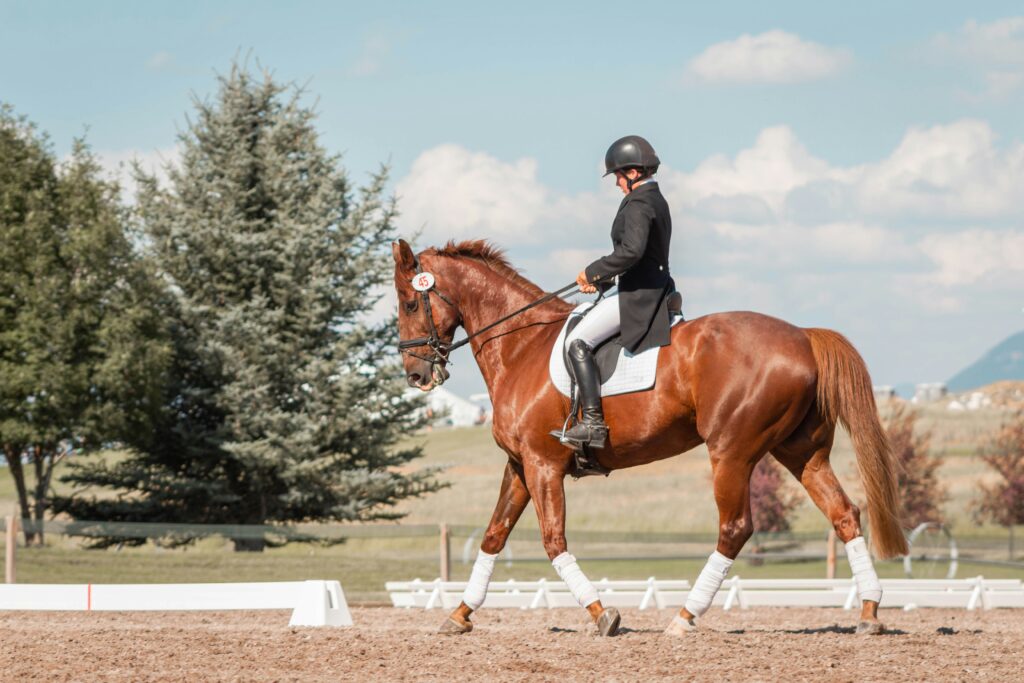
Many riders try to “correct” the horse with more leg, more hand, or more impulsion. But what really matters is this: the rider’s coordination and clarity are crucial, and the horse responds when the rider’s body finally helps instead of interfering.
So I train the rider-me like an athlete:
- I improve my symmetry, because my horse mirrors it.
- I improve my balance, because my horse carries my balance.
- I improve my timing, because my horse lives in rhythm.
In addition, I remind myself of a hard truth: if my body gives confusing signals, my horse cannot “choose” the correct response consistently. Therefore, I simplify my aids and clean up my seat. This is where my core stability matters. I do not mean stiffness. I mean stable alignment with soft joints. So my pelvis can follow, while my trunk stays organized.
Simple self-checks that protect my horse’s back
I do not need complicated tools to start. Instead, I use fast checks that keep me honest.
1) The “mirror test” mindset
I begin with an exercise: I imagine I am the horse and then observe how a nudge changes its posture. I apply that idea to myself. I ask myself: Am I sitting like a soft backpack or like a weight bouncing down?
2) My breathing check
If I hold my breath, I usually brace. So I exhale longer than I inhale for a few strides. Then I feel my hips soften.
3) My seat-bone check
I quietly notice whether one seat bone feels heavier. If it does, I correct my alignment first before asking for more.
4) My transition check
Transitions reveal the truth. If my horse hollows or rushes when I sit, I likely land too hard or too late. So I prepare earlier, lighten my seat, and keep the rhythm.
5) My “follow” check
I ask for a few strides where I simply follow. If my horse swings more, I know my seat created the earlier restriction.
And yes, I keep the main goal in front of me: Stop causing back pain in my horse while riding by changing what my body does first.
When I involve professionals and rule out other causes
Rider skill matters. However, pain can also come from outside my technique. Therefore, I do not guess when signs persist.
I involve the right support:
- A qualified saddle fitter, because pressure points can overload the back.
- A veterinarian if I suspect lameness, kissing spines, or persistent back pain.
- A physiotherapist or bodyworker, because muscle guarding can outlast the original trigger.
- A trainer who can coach my seat, because feedback speeds learning.
In other words, I stay humble. I fix what I can control, and I check what I cannot see.
My take-home message for kinder riding
I ride best when I ride with empathy and skill at the same time. My take-home message stays powerful: if discomfort repeats, the body protects itself, and the horse cannot move freely.So I choose softness with structure. I choose balance before strength. And I choose clarity before intensity.
Finally, I repeat the promise that guides my training: Stop causing back pain in my horse while riding—because my horse deserves comfort before performance.